

Ask a child to learn the alphabet, and you are asking them to memorize 26 shapes that mean nothing yet.
We can hang a poster with the letters on the wall, practice their pronunciation together, and copy them onto paper. However, a child who has not yet understood what letters are for has no reason to try. Teaching with a one-sided approach often fails with preschool-aged children.
Interest does not come from repetition.
It comes from answering a question the child actually has.
That is why this book does not start with the alphabet. The story starts with Lina, who cannot wait to read the way her mom does, and finds herself in front of a “wall” of letters. She hears the sounds and sees the shapes but gets frustrated because “these aren’t even words!” Every parent knows that moment. All parents have experienced and are familiar with this moment of initial difficulty. The solution comes when Lina realizes that these strange symbols are the bricks that build every word around her.
Every book at factouli follows one rule: the lesson has to solve the problem in the story. If you were to remove the letters from the plot and the story still made sense, then it wouldn’t be teaching anything substantial.
The amusement park turns learning into something Lina lives through. The alphabet stops being a poster on the wall and becomes a map. Before they go in, her mom points at the big “A” at the entrance and says that if they lose each other, that is where they meet. But Lina was already thinking about the rides she could see inside.
Then, in the middle of the excitement, Lina lets go of her mom’s hand and gets lost. The park stops being fun. She is on her own, she is frightened, and the only thing that can help her is a letter she had not paid much attention to.
From the “A” that stands for safety and a meeting point, to the “B” and the “D” found among the rides, Lina understands that letters are the key that unlocks the world around her.
The next morning she asks, on her own, to learn the letters. Nobody had to ask her. She now has the right motivation. She understands why. That is something no worksheet can do.
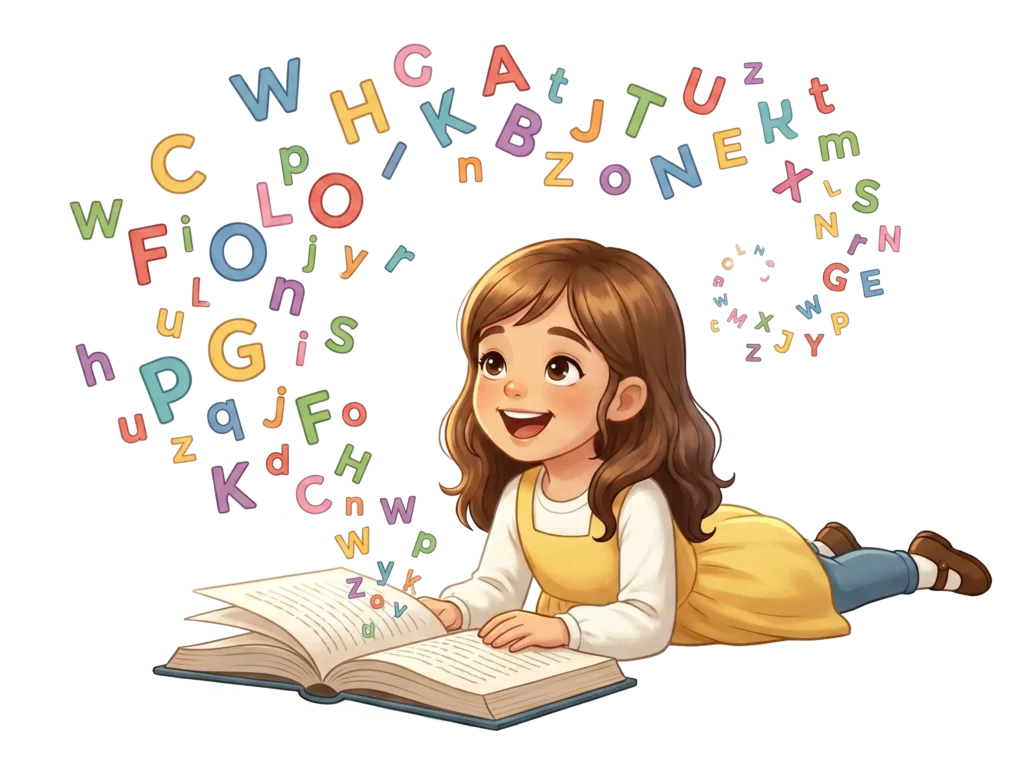
Although the title focuses on the alphabet, this book offers valuable lessons that go beyond narrow academic knowledge, with personal safety being the central theme.
Through Lina’s adventure, children learn the rule that works in real life in the clearest possible way: always agree on a meeting point before you go into a crowded place. It is a ten-second habit, and a child who has heard this story understands at once why it matters. Learning it from a book is far better than experiencing it unprepared in real life.
The story also builds emotional resilience. When Lina realizes she is lost, she feels the fear as a knot in her stomach. But she does not panic. She closes her eyes, takes a deep breath, and tries to think clearly, bringing back what her mom had told her. This is a valuable lesson in self-regulation for any child facing a difficult or stressful situation.
And one more thing. The child is not just sitting and listening. The letters do not stay on the poster. Lina meets them in a place that interests her, together with fear, relief, and curiosity. Those stay. Those are the things that stick. Memorization is forgotten.
130 pages in total, for ages 3 to 6.
It includes the 45 page story, the same 45 pages again as outlines to color, and 40 pages of letter cards for tracing and matching. An alphabet poster is included.
It is a digital file in PDF format, yours the moment you buy it. Print it at home, take it to a print shop, or use it directly on a tablet, computer or phone. Nothing will be shipped.
Read it from a tablet, a phone or a computer. No connection needed, and nothing to carry in the bag.
Let your child color the scenes from the book you just read. See which details stayed with them.
Cut out the cards and match them. You can also play by finding the real objects around the house.
Practice over the dotted lines, so the hand learns the right movement and direction for each letter.